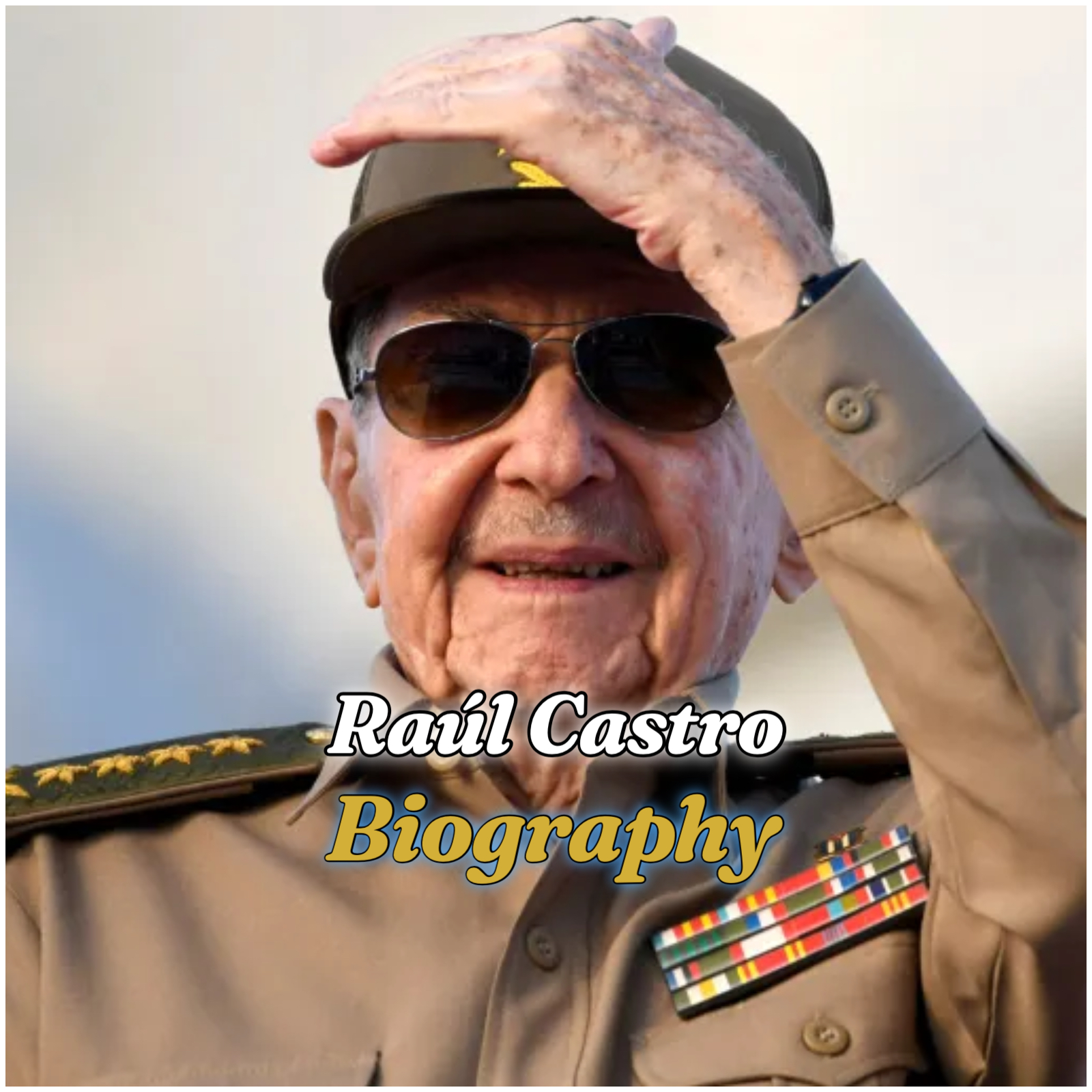
Introduction Raúl Castro Biography
Raúl Castro is a Cuban revolutionary leader, military commander, and politician who played a central role in shaping modern Cuba. Born on June 3, 1931, in Birán, Cuba, he became internationally known as one of the key figures behind the Cuban Revolution alongside his older brother, Fidel Castro, and revolutionary leader Che Guevara. Over several decades, Raúl Castro emerged as one of the most powerful political and military figures in Latin America, helping establish and maintain Cuba’s communist government after the fall of Fulgencio Batista in 1959.
Raúl Castro spent most of his political career overseeing Cuba’s armed forces and national security institutions. Known for his disciplined and pragmatic leadership style, he served as Cuba’s Minister of the Revolutionary Armed Forces for nearly fifty years before officially becoming President of Cuba in 2008 following Fidel Castro’s illness and retirement. During his presidency, he introduced economic reforms, expanded limited private business opportunities, and played a major role in restoring diplomatic relations between Cuba and the United States during the Obama administration.
In 2026, Raúl Castro returned to global headlines after the United States announced criminal charges connected to the 1996 shootdown of civilian aircraft linked to the exile organization Brothers to the Rescue. The development renewed international debate over his long political legacy, human rights controversies, and Cuba’s historic tensions with the United States. Despite retiring from official leadership positions, Raúl Castro remains one of the most influential and recognizable figures in Cuban political history.
Early Life and Background of Raúl Castro
Raúl Castro was born on June 3, 1931, in Birán, a small rural town in Oriente Province, Cuba. He was born into a large and influential family led by his father, Ángel Castro, a wealthy Spanish immigrant farmer, and his mother, Lina Ruz González. Raúl grew up alongside several siblings, including his older brother Fidel Castro, who would later become one of the most famous revolutionary leaders in world history. His childhood was spent on the family’s large agricultural estate where he witnessed both wealth and the harsh living conditions faced by poor Cuban workers around him.
During his early years, Raúl developed a quiet but determined personality. Unlike Fidel, who was known for strong public speeches and charisma from a young age, Raúl was more reserved, disciplined, and deeply interested in organization and military structure. He attended Jesuit and Catholic schools during his childhood, where he received strict religious and academic training. Growing up in a politically tense Cuba also shaped his worldview, especially as social inequality and political unrest increased across the country during his teenage years.
As a young man, Raúl became attracted to socialist and communist ideas. He became actively involved in student activism and political movements opposing the government of Cuban leader Fulgencio Batista. His revolutionary passion eventually pushed him into armed struggle alongside Fidel Castro during the 1950s. Those early experiences in politics, family influence, and revolutionary activism laid the foundation for his future rise as one of Cuba’s most powerful military and political leaders.
Education of Raúl Castro
Raúl Castro received his early education in Cuba through Catholic and Jesuit institutions, which were known for strict discipline and strong academic standards. During his childhood, he attended religious schools alongside his brother Fidel Castro. These schools played an important role in shaping his character, teaching him discipline, structure, and leadership qualities that later became visible throughout his political and military career. His early education exposed him to both traditional academics and strong ideological discussions during a politically unstable period in Cuban history.
After completing his primary and secondary education, Raúl Castro pursued higher studies in the social sciences. However, his academic journey was heavily interrupted by growing political activism and revolutionary involvement. Unlike many political leaders who followed a long university path, Raúl became increasingly focused on political organization, revolutionary strategy, and military preparation during his youth. His interest in socialist ideology and anti-government activism became stronger than his commitment to formal classroom education.
Although Raúl Castro did not become widely known for academic achievements or advanced university degrees, his real education came through revolutionary experience, military leadership, and decades of government administration. Over the years, he gained extensive practical knowledge in defense strategy, intelligence operations, diplomacy, and state governance. His combination of ideological training, disciplined schooling, and revolutionary experience eventually helped him rise to become one of the longest-serving military and political leaders in Cuba’s history.
Career Journey and Political Rise of Raúl Castro
Raúl Castro began his political and revolutionary career during the early 1950s when he joined movements opposing the government of Cuban leader Fulgencio Batista. Influenced by socialist ideology and revolutionary activism, he worked closely with his older brother Fidel Castro in organizing resistance against the Batista regime. One of his earliest major political actions came in 1953 when he participated in the failed attack on the Moncada Barracks, an event that later became a defining moment in the Cuban Revolution. After the attack failed, Raúl was arrested and imprisoned alongside other revolutionaries before later receiving amnesty.
Following his release from prison, Raúl Castro went into exile in Mexico where he reunited with Fidel Castro and other revolutionaries, including Che Guevara. Together, they organized the revolutionary movement that returned to Cuba aboard the yacht Granma in 1956. During the guerrilla war in the Sierra Maestra mountains, Raúl emerged as a disciplined military commander and trusted strategist. His leadership abilities helped strengthen the revolutionary forces as they fought against Batista’s army. When Batista fled Cuba in January 1959, the revolution succeeded and Raúl quickly became one of the most powerful figures in the new Cuban government.
After the revolution, Raúl Castro was appointed Minister of the Revolutionary Armed Forces, a position he held for nearly five decades. Under his leadership, Cuba built one of the strongest military systems in Latin America and developed close military ties with the Soviet Union during the Cold War. He also supervised intelligence operations, national defense structures, and military modernization programs. Throughout these years, Raúl was widely viewed as the operational backbone of the Cuban government while Fidel Castro remained the public face of the revolution.
Raúl’s career entered a new phase in 2006 when Fidel Castro became seriously ill and temporarily transferred presidential powers to him. In 2008, Raúl officially became President of Cuba. As president, he introduced several economic and administrative reforms aimed at modernizing Cuba’s economy while maintaining communist rule. His government allowed limited private business ownership, expanded access to mobile phones and travel opportunities, and reduced certain state restrictions on citizens. One of the defining achievements of his presidency came in 2014 when Cuba restored diplomatic relations with the United States during the administration of President Barack Obama.
Raúl Castro stepped down as President of Cuba in 2018 and later retired as leader of the Communist Party in 2021, marking the end of direct Castro family rule in Cuba. Despite leaving official office, he continued to hold symbolic influence within Cuban politics and remained an important figure in the country’s revolutionary history. In 2026, his career and legacy returned to international attention after the United States announced criminal charges linked to the 1996 shootdown of civilian aircraft operated by the exile group Brothers to the Rescue. His long political journey, spanning revolutionary warfare, military leadership, and national governance, secured his place as one of the most significant figures in modern Cuban history.
U.S. Criminal Charges Over the 1996 Brothers to the Rescue Shootdown
Raúl Castro is currently trending internationally after the United States announced criminal charges connected to the 1996 shootdown of two civilian aircraft operated by the Cuban exile organization Brothers to the Rescue. The case, which remained one of the most controversial incidents in U.S.-Cuba relations for decades, has once again pushed Raúl Castro into global political discussions. American prosecutors accused him of involvement in conspiracy and actions linked to the destruction of the aircraft, an incident that resulted in the deaths of four people and intensified tensions between Cuba and the United States at the time.
The announcement generated widespread international media attention because Raúl Castro remains one of the most influential figures in Cuba’s revolutionary history. Although he officially retired from political leadership years ago, the new legal developments revived debates surrounding his role in Cuba’s military operations, intelligence system, and long-standing communist government. Political analysts, historians, and human rights organizations have continued discussing the impact of the allegations and what they could mean for future U.S.-Cuba diplomatic relations.
The Cuban government strongly rejected the accusations and described the charges as politically motivated attacks against the country’s revolutionary leadership. Supporters of Raúl Castro argue that he defended Cuban sovereignty during decades of political pressure from foreign governments, while critics continue pointing to allegations of authoritarian rule and political repression under the Castro administration. As a result of these developments, Raúl Castro’s name has once again become one of the most searched and discussed topics connected to Cuban politics in 2026.
Personal Life, Wife, and Family of Raúl Castro
Raúl Castro was married to Vilma Espín, one of the most respected female figures of the Cuban Revolution. Vilma was a revolutionary activist, engineer, and women’s rights advocate who played an important role in Cuba’s political development after the revolution. Their marriage became one of the most influential political partnerships in Cuban history, and together they built a strong family while remaining deeply involved in national leadership. The couple had four children and maintained a relatively private family life despite their enormous political influence.
Compared to his older brother Fidel Castro, Raúl was widely known for being quieter, more disciplined, and less publicly dramatic. He preferred a reserved lifestyle and was often described as practical, organized, and highly focused on military and government administration. Throughout his decades in power, he rarely sought the spotlight and usually avoided the charismatic public performances that made Fidel internationally famous. This personality difference helped shape his image as a calmer and more methodical political leader.
Family remained an important part of Raúl Castro’s personal identity throughout his life. His wife Vilma Espín remained a major emotional and political support system until her death in 2007. Despite leading one of the world’s most politically sensitive governments, Raúl attempted to keep much of his personal life away from excessive public attention. His long marriage, disciplined character, and private lifestyle contributed to the image of a leader who valued structure, loyalty, and stability both in politics and within his family life.
Beyond politics, Raúl Castro was also known for his strong interest in military organization, national defense, and revolutionary ideology. He spent most of his adult life focused on protecting and maintaining the Cuban revolutionary system established in 1959. Supporters viewed him as loyal to Cuba’s sovereignty and socialist identity, while critics associated his leadership with political restrictions and state control. Regardless of public opinion, his personal life remained closely tied to the revolutionary movement that defined his entire career and legacy.
Raúl Castro Age, Religion, Height, Ethnicity, and Physical Appearance
Raúl Castro was born on June 3, 1931, which makes him 94 years old as of 2026. He was born in Birán, Oriente Province, Cuba, into a family of Spanish and Cuban heritage. Ethnically, Raúl Castro is of Spanish descent through his father, Ángel Castro, who immigrated from Spain to Cuba. Unlike tribal classifications commonly used in some African countries, Cuba’s social identity is more connected to ethnicity and national background rather than tribal divisions.
Raúl Castro was raised in a Roman Catholic household and attended Jesuit and Catholic schools during his early years. His religious upbringing exposed him to strict discipline and moral teachings, although his later political ideology became strongly associated with communism and socialist governance. Throughout his political career, he was more publicly connected to revolutionary ideology and state leadership than open religious practice.
Physically, Raúl Castro is known for his modest and disciplined appearance. He is estimated to stand around 5 feet 7 inches tall and usually appeared in military uniforms during most of his public life, especially while serving as Cuba’s Minister of the Revolutionary Armed Forces and later as President. He maintained a calm facial expression, serious demeanor, and simple personal style that reflected his reserved personality and military background.
As he grew older, Raúl Castro became recognized for his aging but still commanding appearance, often seen with gray hair, glasses, and his signature military posture during official state ceremonies. His physical appearance, combined with his quiet leadership style, helped shape the global image of a disciplined revolutionary leader who spent decades at the center of Cuban politics and military power.
Raúl Castro Net Worth and Sources of Income
Raúl Castro has long been regarded as one of the most powerful political figures in Cuba, although his exact personal net worth has never been publicly confirmed. Unlike many global political leaders connected to private businesses or corporate ownership, Raúl Castro spent most of his life within Cuba’s communist political system, where state control over major industries limited the visibility of personal wealth. Despite this, international reports and political analysts have often estimated that the Castro family controlled access to significant state resources and enjoyed privileges connected to their leadership positions.
Throughout his career, Raúl Castro’s primary source of income came from his roles within the Cuban government and military establishment. He served for decades as Minister of the Revolutionary Armed Forces before becoming President of Cuba from 2008 to 2018. His leadership positions provided access to state residences, official transportation, security services, and government-controlled benefits rather than publicly declared corporate earnings or commercial investments. Because Cuba operates under a socialist economic structure, financial transparency surrounding senior political leaders has historically remained limited.
Some international media reports and political critics have speculated about hidden wealth, offshore holdings, and indirect control of state-linked enterprises connected to Cuba’s leadership circle, although many of these claims remain disputed and difficult to independently verify. Supporters of Raúl Castro have consistently argued that he lived a relatively modest and disciplined lifestyle compared to leaders associated with luxury and excessive personal spending. His public image was generally centered around military simplicity, revolutionary discipline, and state service rather than displays of personal wealth.
Although no officially verified figure exists, various unofficial estimates over the years have placed Raúl Castro’s potential net worth in the multi-million-dollar range due to his decades of political influence and access to state-controlled resources. Regardless of financial speculation, his true legacy is more strongly connected to political power, military leadership, and his role in shaping modern Cuba than to personal business success or commercial fortune.
Legacy and Impact of Raúl Castro
Raúl Castro left behind one of the most influential and controversial political legacies in modern Latin American history. As one of the leading figures of the Cuban Revolution, he helped overthrow the government of Fulgencio Batista in 1959 and played a central role in establishing Cuba as a socialist state. For decades, he controlled the country’s military structure and became a key architect of Cuba’s national defense system. His loyalty to the revolutionary movement and his long partnership with Fidel Castro ensured that his influence remained deeply rooted in nearly every aspect of Cuban politics and governance.
During his presidency, Raúl Castro became known for introducing cautious economic reforms while still preserving Cuba’s communist political structure. He expanded limited private business opportunities, eased certain restrictions on travel and technology, and helped restore diplomatic relations between Cuba and the United States during the Obama administration. Supporters viewed these actions as signs of modernization and practical leadership, while critics argued that political freedoms and human rights remained heavily restricted under his administration. Even after retiring from office, his policies continued shaping Cuba’s political and economic direction.
Raúl Castro’s legacy continues to divide global opinion. Admirers see him as a disciplined revolutionary leader who defended Cuban sovereignty against decades of foreign pressure and maintained national stability through difficult economic periods. Critics remember him as part of a government accused of political repression, censorship, and authoritarian rule. Regardless of differing perspectives, his impact on Cuban history is undeniable. His decades of military leadership, revolutionary influence, and political power secured his place as one of the defining figures in the history of twentieth and twenty-first century Cuba.
Conclusion
Raúl Castro remains one of the most significant and debated political figures in modern world history. From his early involvement in the Cuban Revolution to his decades of military leadership and eventual presidency of Cuba, he played a major role in shaping the country’s political identity, socialist system, and international relations. Known for his disciplined leadership style and long-standing influence within the Cuban government, Raúl Castro left behind a legacy marked by revolutionary loyalty, political power, economic reforms, and global controversy. Even after retirement, his name continues to carry strong historical and political importance both within Cuba and internationally.
Frequently Asked Questions About Raúl Castro
1. Who is Raúl Castro?
Raúl Castro is a Cuban revolutionary leader, former president, and military commander who played a central role in the Cuban Revolution alongside his brother Fidel Castro and later ruled Cuba from 2008 to 2018.
2. How old is Raúl Castro?
Raúl Castro was born on June 3, 1931, which makes him 94 years old as of 2026. He remains one of the oldest surviving revolutionary leaders connected to modern Cuban history.
3. What is Raúl Castro famous for?
Raúl Castro is famous for helping lead the Cuban Revolution, serving as Cuba’s Minister of the Revolutionary Armed Forces for decades, and later becoming President of Cuba after Fidel Castro stepped down from power.
4. Is Raúl Castro still alive?
Yes. Raúl Castro is still alive as of 2026. Although retired from official leadership positions, he occasionally appears during important Cuban national ceremonies and political events.
5. Who was Raúl Castro’s wife?
Raúl Castro was married to Vilma Espín, a respected Cuban revolutionary, engineer, and women’s rights activist. Their marriage became one of the most influential political partnerships in Cuba’s revolutionary history.
6. Did Raúl Castro have children?
Yes. Raúl Castro and his wife Vilma Espín had four children together. Members of the Castro family have remained influential within Cuban political and public life over the years.
7. When did Raúl Castro become President of Cuba?
Raúl Castro officially became President of Cuba in 2008 after Fidel Castro retired due to health problems, although he had already been acting as Cuba’s leader since 2006.
8. What reforms did Raúl Castro introduce in Cuba?
During his presidency, Raúl Castro introduced economic reforms that expanded private businesses, eased some travel restrictions, improved access to mobile technology, and opened limited economic opportunities for Cuban citizens.
9. Why is Raúl Castro trending in 2026?
Raúl Castro is trending in 2026 because the United States recently announced criminal charges related to the 1996 shootdown of civilian aircraft connected to the exile organization Brothers to the Rescue.